
RISE UP – For the Ocean | 2026
As offshore wind energy expands globally, new research coordinated by RISE UP For the Ocean highlights the importance of protecting small-scale fisheries, coastal livelihoods, and marine ecosystems while ensuring communities have a meaningful voice in the energy transition.
Drawing on six country studies from India, the Philippines, South Africa, Namibia, Colombia and Brazil, the research explores how offshore wind development intersects with existing uses of marine space and what is needed to support a just and inclusive energy transition.
The findings, brought together in the global synthesis report Coastal Communities and Offshore Wind Development: International Perspectives from Six Countries, identify four key challenges and six practical recommendations for policymakers, developers and other stakeholders.
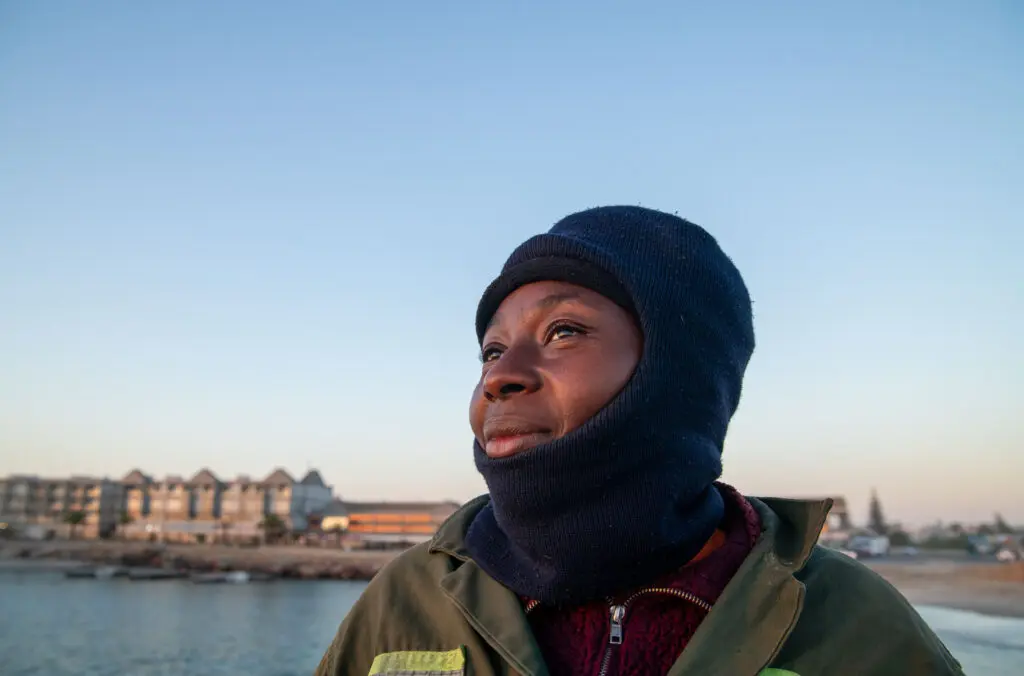
Shiwaovanhu Paulus, one of the few female fishers in the area, is fishing at the Platz Am Meer breakwater jetty in Swakopmund, on Namibia’s west coast.
Across the six countries, the research identifies four interconnected findings that highlight why coastal communities must be involved in offshore wind planning from the outset.
Coastal communities need early access to clear, accessible information and genuine opportunities to influence offshore wind planning and decision-making.
The research highlights gaps in awareness and participation, particularly where communities are consulted only after major decisions have already been made. It also emphasizes the importance of including women, Indigenous peoples, and other groups whose perspectives may be overlooked in formal consultation processes.
Offshore wind projects are being planned in marine areas already used for fishing, navigation, tourism, conservation and other activities.
The research highlights the need to recognize fishing grounds, navigation routes, culturally significant areas and sensitive marine ecosystems when planning offshore wind infrastructure. It also points to the importance of assessing cumulative environmental and socioeconomic pressures rather than considering projects in isolation.
Small-scale fisheries support entire coastal economies, including fish processing, trading, transportation, marketing and household livelihoods.
Potential changes to fishing access, marine ecosystems, or fishing activities can affect a much wider range of people than those directly fishing at sea. The research highlights the importance of recognizing women fishworkers, processors, traders and other community members in impact assessments and decision-making.
Coastal communities do not hold a single position for or against offshore wind development.
Their perspectives are shaped by how projects are planned, how potential impacts are addressed, and whether communities can access information, influence decisions and benefit from development.
Transparent processes, credible environmental and livelihood safeguards, accessible grievance mechanisms and locally relevant benefits are essential to building trust.
Based on the findings from the six country studies, the global synthesis outlines six recommendations to help ensure that offshore wind development supports climate goals while protecting coastal communities and marine ecosystems.
Together, these recommendations call for a shift from reactive consultation toward proactive planning with coastal communities.
To better understand how offshore wind development intersects with coastal communities, RISE UP worked with local partners to bring together research from six countries at different stages of offshore wind development.
The country studies combine community interviews, stakeholder perspectives, policy reviews, and technical assessments, reflecting the different contexts in which offshore wind is being explored and developed.
Offshore wind can contribute to renewable energy development and climate action, but its expansion also introduces new demands on marine spaces that already support communities, livelihoods, and biodiversity.
The six country studies show that achieving a just energy transition requires more than technical planning and formal consultation. It requires recognizing the knowledge, rights, and priorities of coastal communities and ensuring they can meaningfully influence decisions.
The research also highlights that offshore wind development must be considered alongside existing pressures on marine ecosystems and coastal livelihoods, including climate change, conservation measures, shipping and other marine industries.
By bringing together community perspectives and policy analysis, the project provides evidence to support more inclusive approaches to offshore wind development and marine spatial planning.

The six country reports and global synthesis provide a foundation for continued dialogue among coastal communities, civil society organizations, researchers, policymakers and the renewable energy sector.
Through this research, RISE UP aims to advance the visibility of frontline community perspectives in ocean and climate policy discussions and support approaches to offshore wind development that advance climate action while respecting coastal livelihoods and marine ecosystems.
A just energy transition must recognize that the ocean is not an empty space, but a place of livelihoods, cultures, biodiversity and longstanding community connections.
Explore the findings, community perspectives and recommendations in the full research reports.
Global Synthesis Report
Explore the research and perspectives from each of the six countries: India | Philippines | South Africa | Namibia | Colombia | Brazil
Coastal Perspectives Video
Hear directly from coastal communities and explore their perspectives on offshore wind development and the energy transition.
Toolkit
Explore practical resources to support community engagement, informed participation and more inclusive offshore wind planning. https://trello.com/b/HziVyGvH/coastal-communities-and-offshore-energy-transition